It would be difficult to find anyone who has not at least heard the word autism. Advocacy groups have done a great job of bringing the medical term into the mainstream. It’s no longer the abstract diagnosis it once was.
Most people don’t have a real grasp on understanding autism spectrum disorders but have had some type of contact with it. They may have encountered a student in their child’s classroom or a friend’s child. Some have only seen a character on a television police drama, that shows a child with autism as the only witness to a crime. While others have watched documentaries.
The quote from Dr. Stephen Shore states, “If you have met one child with autism, you have met one child with autism”. This spectrum has no rules or patterns that are consistent enough to narrow it down in any aspect. Whatever your experience with autism, you still won’t know everything about autism.
I had never heard the word until it was mentioned as a possibility for my son’s developmental delays. The closest moment I ever had to hear about it was from my mother when I was 10 years old. She misunderstood and thought they said, “artistic”.
My mother worked for a company that offered the opportunity for the employees to donate to different charities. She was more than happy to donate and chose what she thought were “artistic children”. That was until they showed her the truth.
The company provided, for lack of a better word, field trips. The employees could see firsthand the charities they had chosen to help. My mother was under the impression that she was going to see gifted students in an art class.
She was confused when they were driven to the local children’s hospital. She thought perhaps there was an art room inside. To her consternation, they were taken to a room that had a large window. On the other side of the window was a little girl. She was placed in front of a puzzle but chose to sit and rock in the corner the entire visit.
My mother left upset and filled with sadness. The presenter explained that the little girl had autism. Those of us who know the dismal picture, that was always painted for our kids, know full well the information fed to the visitors was as grim as they could paint it.
Of course, my mother opted to continue her donation to help the little girl and any other children under this type of care. She arrived home from work in a sad mood and explained what she had seen. I didn’t understand why an artistic little girl would be given a puzzle instead of art supplies.
To be fair, this event occurred in the early 1980s. The medical community had finally stopped diagnosing all childhood psychiatric disorders as schizophrenia. It would be 20 years later before I would recall this information.
Misdiagnosis and the Legacy of Misunderstanding
In like manner, a friend was diagnosed with schizophrenia at the age of eight. He was labeled because of the exaggeration of his teenage mother. She wanted to be young and free from motherhood. He was at most an active little boy. His diagnosis in the 1970s came after playing superheroes with his friend. They were in an abandoned building, on the second floor.
They dared each other to jump down from the immense height. When they counted to three, one jumped the other didn’t. Until this day you can still see the scars from the repair of his shattered ankle. That was all she needed to convince them that he should be sent away.
It worked. He was placed in a facility, but not permanently. The facility was closed soon after and he returned home. I don’t know if I would consider it a good thing. Being in a facility with kind strangers or in a home where you aren’t wanted is a bit of a conundrum, but I digress.
Over the years the medical community has tried to understand and create strategies to “fix” our kids. Confusion persists. There’s not even a consensus on whether it is a mental disorder, neurological disorder, or an autoimmune response. There’s only one thing concrete about autism. It exists.
Our kids have varying degrees of the disorder. They also have different ages of verifiable symptoms. My son was diagnosed at the age of three but was showing delays much sooner. He went completely silent at 14 months. Some kids are not demonstrative at birth and are diagnosed then. Others have regressed into autism after entering elementary school. I have met six families that experienced this.
These variances are a few reasons that autism is so elusive. Parents are left scrambling without any true recourse. I know I’ll never forget that day. I think it was the first time I went completely numb.
***
The Day of the Diagnosis
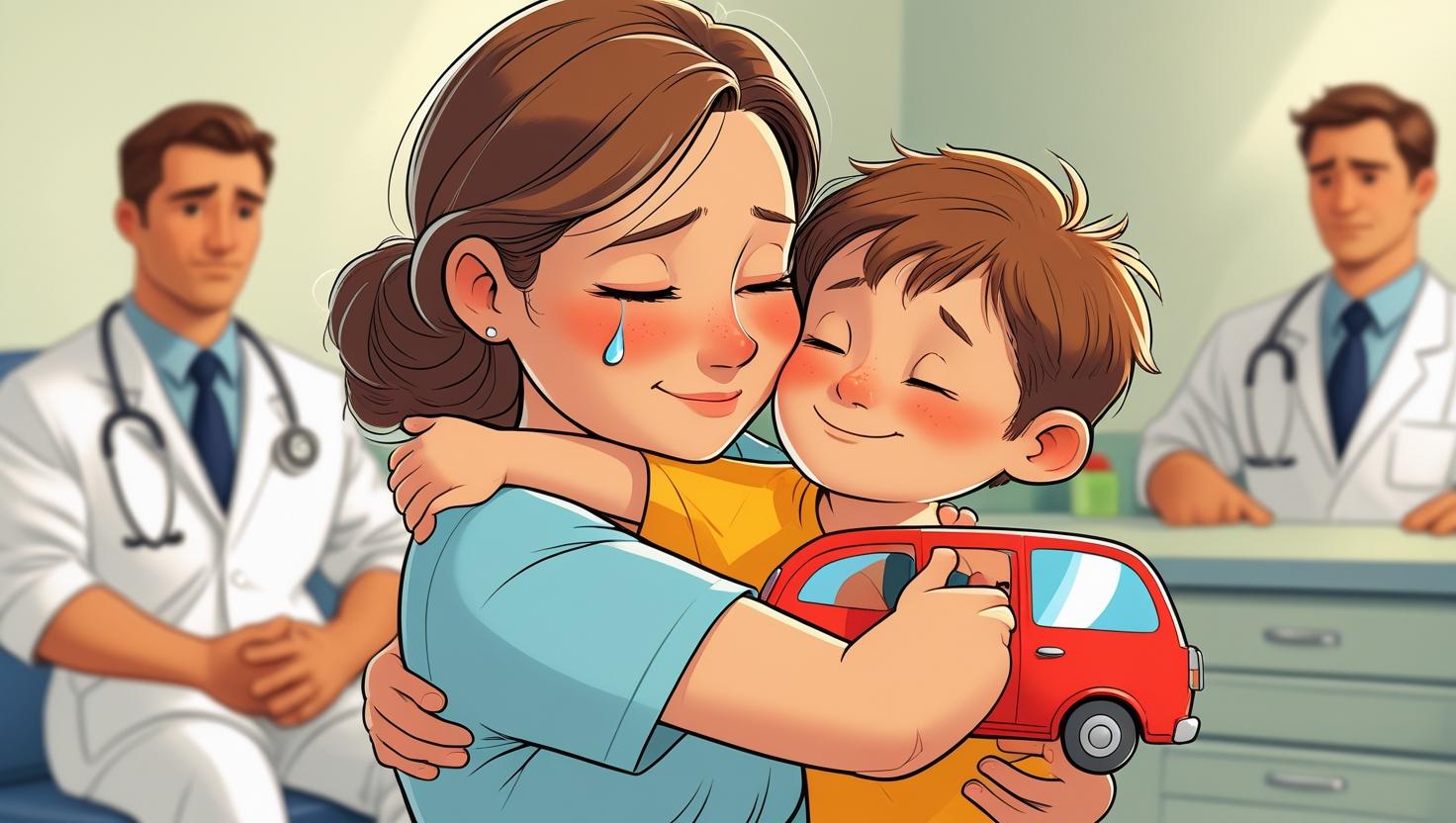
In the room were two very kind and caring doctors. They had compiled the information from the weeklong evaluation. My son and I, of course, were there. My sister came along for support.
I know they were saying words. I could hear them. I couldn’t understand them. It was like they were speaking another language. I looked over at Michael and could only see him. Everyone else disappeared.
More than anything I wanted to wrap him in my arms and run away to safety. I couldn’t move. I heard them say, “You can cry if you need to”. Then, I heard my sister respond, “We don’t need to cry. We need to know what to do now.” Still, I couldn’t clearly hear them.
I have no idea what was said after that. I was handed a packet of information and bid farewell. Finally, I could wrap my arms around my son who was playing on the floor. There wasn’t a safe place for me to run to. One by one, all those words dropped into my conscious mind, and I understood them. I finally understood them.
The Self-Reflection Spiral: What did I miss?
Prior to the evaluation, I had to do the only thing I knew to do. I hit the library with full steam. I was on my fourteenth book when we had the first appointment. I wasn’t looking for answers. I was looking for questions.
What should I ask? What did I think? What had I done wrong? My pregnancy was textbook. It’s like he read the pregnancy books and marked his calendar. On the first day of the 13th week, the morning sickness stopped. He and I embarked on a food journey together.
That’s what we all do, right? We go over every moment that we can remember. We work through everything we ate, smelled, and experienced. It can become overwhelming. After which I blamed myself for not asking more questions sooner. Why didn’t I see it? I accepted him for everything he was and wasn’t. Was I wrong to do that?
Transition: From Grief to Action
Coming to terms with the diagnosis was one journey. Learning how to help my son thrive was another. After the shock wore off and the questions settled into something more manageable, I began searching for tools — therapies, treatments, and approaches that might support his development and ease his challenges. What I found was a sea of options, advice, and opinions — some helpful, others not so much. But along the way, I learned how to navigate this world, piece by piece.
Beyond the self-inflicted torture, the fact is that it’s all right. I did what I was supposed to do. I loved him unconditionally. That was enough.
I remind him every day of how much I love him and that he’s my favorite person in the whole world. The truth is that he’s the best person I know. I can honestly say that I’ve been happy for the past 23 years because of him. He’s the best present I have ever gotten.
Leave a Reply